
Documented chain of custody.
Your recycling chain of custody documentation should connect the material to the instruction, the processing and the report. Anchor Resource Group coordinates a consistent record with each executing operator.
Request a program review
Scheduled pickup or inbound delivery.
Your program assigns a load reference and seal number. The originating site, material and disposition instructions are identified before movement.
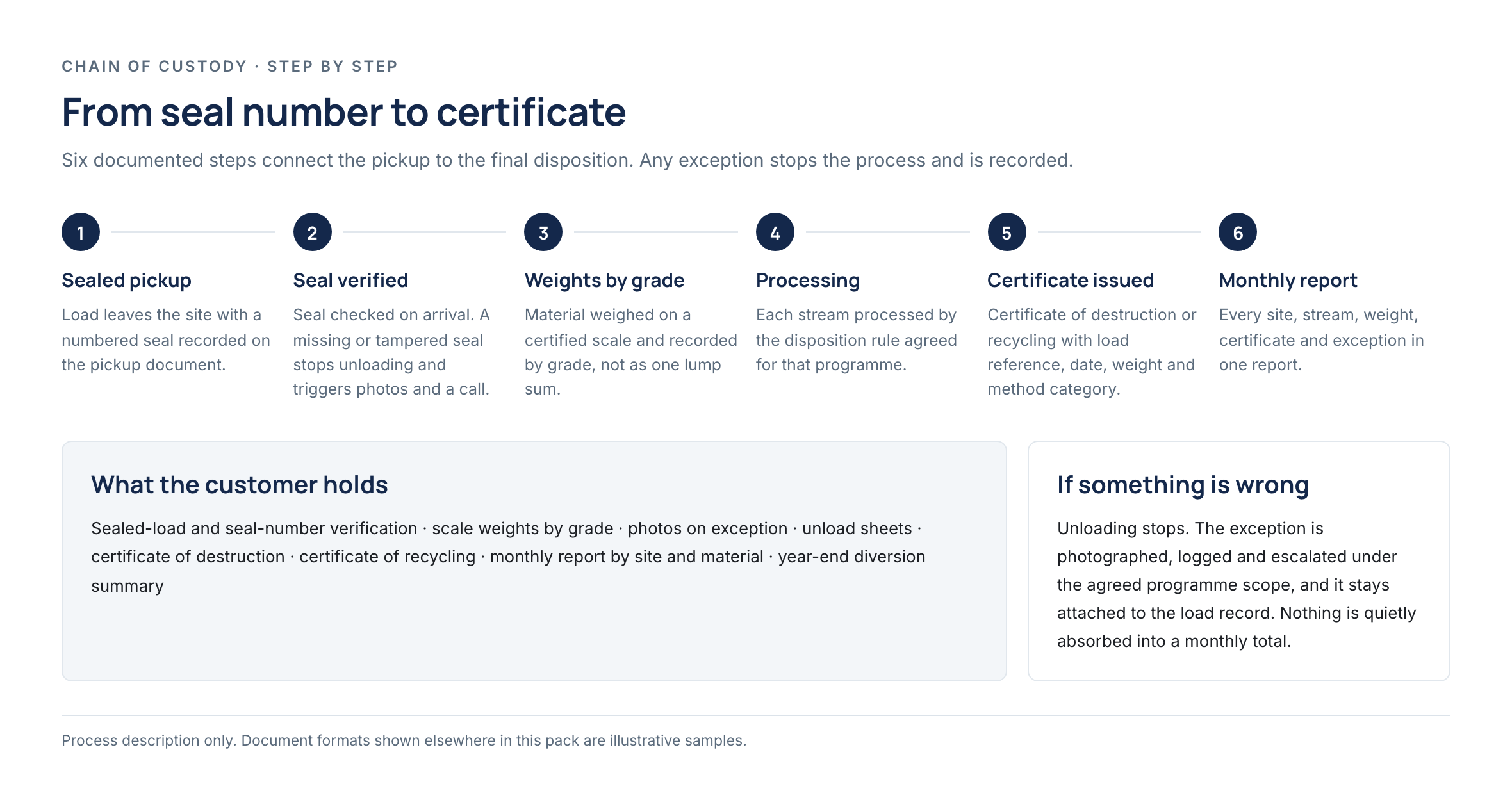
Chain of custody, step by step
From seal number to certificate.
Six documented handoffs connect pickup to final disposition. The agreed program defines responsibilities and escalation.
Sealed pickup
The load leaves with a numbered seal recorded on the pickup document.
Seal verified
The seal is checked on arrival. A missing or tampered seal stops unloading and triggers photos and team escalation.
Weights by grade
Material is weighed on a certified scale and recorded by grade, not as one lump sum.
Processing
Each stream follows the disposition rule agreed for the program.
Certificate issued
The destruction or recycling record connects the load reference, date, weight and method category.
Monthly report
Every site, stream, weight, certificate and exception connects in one report.
What the customer holds
Seal verification, scale weights by grade, exception photos, unload sheets, disposition certificates, monthly site/material reporting and a year-end diversion summary. Document requirements are agreed for the program.
If something is wrong
Unloading stops. The exception is photographed, logged and escalated under the agreed scope. Its resolution stays attached to the load record. Nothing is quietly absorbed into a monthly total.
Process description only. Document formats shown elsewhere are illustrative samples, not valid operating records.
View the complete original artwork

Seal verified on arrival.
The operator checks the seal against the inbound record. A missing or tampered seal stops unloading and triggers photographs and escalation. Exceptions are documented before a release decision.

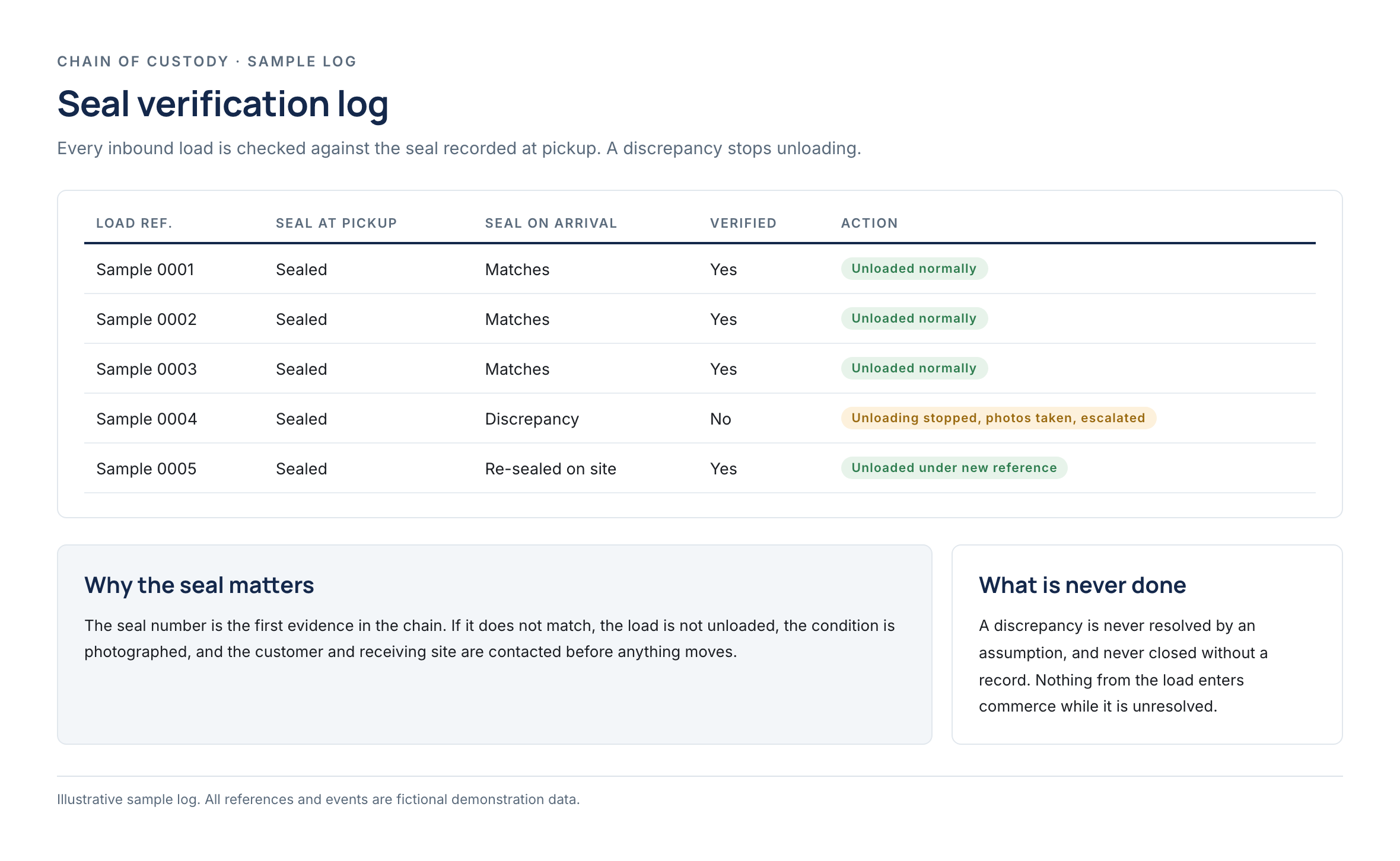
Weights recorded by grade.
The operator records scale weights by the program's material grades with the agreed scale and measurement method, with certification verified where required. The record identifies the load so intake and processing can be reconciled.

Processed under your disposition rule.
The material follows the approved destruction, recycling or recovery instruction. Changes require the program's authorization process, not an undocumented operator decision.
Certificate issued.
The destruction or recycling certificate identifies the load reference, date, weights and method category. A certificate supports the recorded event, not an unrelated certification claim.

Monthly report by site and material.
Your report connects the site, stream and service to weights, certificates and exceptions. Year-end summaries follow the same reporting boundary.

See the records connect.
Review a fictional monthly report with material weights, disposition records and a documented exception. Your program defines the actual evidence requirements.
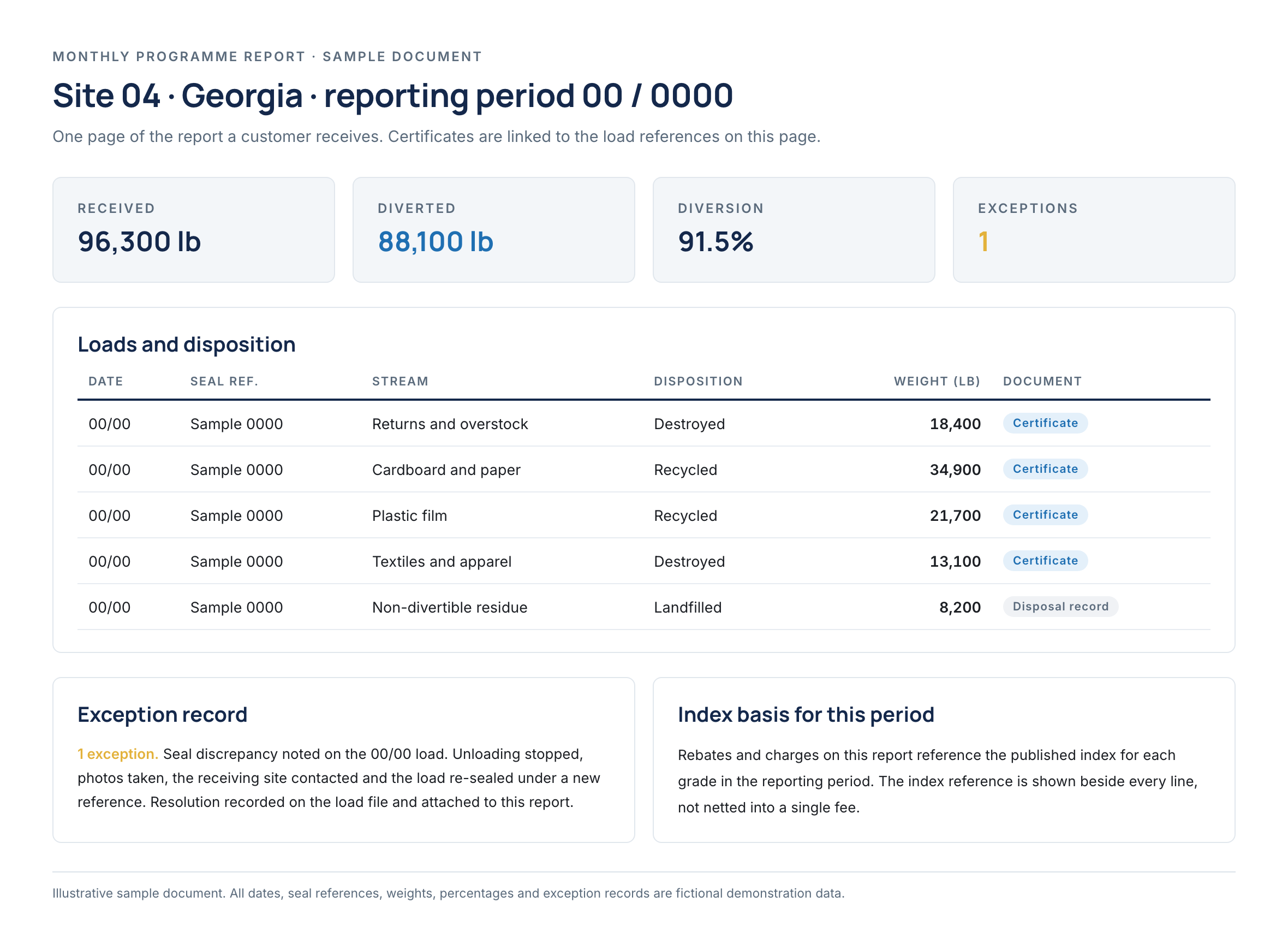
Monthly program report, illustrative sample
One site. Connected records.
Sample Site 04, Georgia. Reporting period 00 / 0000. All values and references are fictional.
- Received
- 96,300 lb
- Diverted
- 88,100 lb
- Diversion
- 91.5%
- Exceptions
- 1
Material flow by weight
Illustrative distribution, not Anchor or operator performance.
Destroyed · Certificate · Sample 0000 · 00/00
Recycled · Certificate · Sample 0000 · 00/00
Recycled · Certificate · Sample 0000 · 00/00
Destroyed · Certificate · Sample 0000 · 00/00
Landfilled · Disposal record · Sample 0000 · 00/00
Exception record
1 fictional exception. A seal discrepancy is noted on the 00/00 load. Unloading stops, photos are taken and the receiving site is contacted. The sample shows resealing under a new reference, with the resolution attached to the load file and report.
Index basis for this period
Eligible rebates and charges reference the published index for each grade and reporting period. The index reference belongs beside each line, not hidden in a single fee. Final terms are agreed in the program.
Illustrative sample. Values are fictional demonstration data, not Anchor or operator results. All dates, seal references, weights, percentages and exceptions are fictional. Unit conversions use 1 lb = 0.45359237 kg.
View the complete original artwork

How custody connects your program.
Anchor coordinates the program. Independent operators perform the services.
Illustrative imagery. The report shown contains fictional data.
Request a program reviewClear answers
What you should know.
What if a seal number does not match?
Unloading stops. The exception is photographed and escalated, and the program's authorization process decides the next action.
Is a certificate enough on its own?
No. Review the certificate alongside intake, weights, approved instructions and exceptions. Those records establish the chain leading to the documented processing event.
How is our material protected from pickup to final disposition?
Start with written material and disposition instructions. Your agreed scope defines the pickup reference, seal control, receiving checks, weights, approved destination, processing evidence and exception escalation. Each handoff needs a responsible party. A seal alone is not proof of destruction.
How do you prevent unauthorized resale of our products?
A destruction-only program must state that resale, donation, substitution and unauthorized diversion are prohibited. Define accepted products, approved methods, custody evidence and subcontracting restrictions before release. Require written authorization for any change. A certificate is supporting evidence, not an absolute guarantee that misconduct is impossible.
What happens if the seal is broken, the load differs or records are missing?
Stop the affected step. Preserve the load reference and evidence, photograph the discrepancy and escalate to the designated contacts. Do not treat a mismatched seal, unapproved destination or missing disposition record as routine completion. The agreed scope defines release authority and incident notification.
How are operators vetted before our material is assigned?
Research and document review cover the legal entity, permits and accepted materials, insurance, facility capabilities, scale/reporting practices and customer requirements. An Anchor facility-management team must visit and audit the facility in person before final vendor approval. A portal application or uploaded certificate is not approval.
What insurance evidence should procurement request?
Request current evidence for the actual entities performing transport and processing, including applicable general liability, commercial auto, workers compensation, cargo or transit and pollution coverage. Limits, exclusions, insured activities, territory and required endorsements must fit the job. A certificate of insurance is evidence, not the policy or an automatic guarantee of coverage. Ask our team to confirm the relevant documentation before release.
Are Anchor and all operators bonded?
Do not assume blanket bonding. If your contract requires a bond, identify the obligation, amount, obligee, surety, term and claim conditions. The required instrument and availability must be confirmed for that contract before work is authorized. A surety bond and liability insurance do not provide the same protection.
Can our team witness destruction or request video evidence?
Include the evidence requirement in the scope before material moves. Availability depends on the facility, method, privacy and safety constraints. Witnessing or video must connect to the actual load reference; generic footage is not evidence that your products were processed.
Will we receive a complete audit package?
Define the required records up front: pickup and seal reference, receiving check, scale weights, disposition record, agreed certificate contents and unresolved exceptions. Your reporting requirements can connect them by site, material and reporting period. Sample reports on this website are fictional layouts, not evidence of a completed customer job.
Can an operator send our material to a different facility?
The approved destinations and change-control rules belong in the scope. An operator should not substitute a destination or subcontract a restricted job without the required written approval and qualification review. The customer must know who is authorized to decide.
How are international movements handled?
State the origin, destination, material classification, intended recovery or destruction and relevant volumes. Applicable import/export, transport and facility-acceptance requirements need review for each jurisdiction before arrangements are confirmed. A worldwide inquiry is not proof that every route or material is permitted.